
Other buildings in Saffron Walden were pargeted during the Arts and Crafts period, but unlike the previous group there is no obvious connection between them. For the purposes of this study the end of the Arts and Crafts period is defined as the outbreak of war in 1914, when fit young pargeters were needed elsewhere.
Table of Contents
18-16 King Street
8- 16 King Street is a tall three storey building with Dutch gables, horizontal banding and decorative window surrounds. Above the first floor windows is an arch infilled with parget. This is hardly visible from the road so it is unlikely that it would be added later and is probably a response to the parget on the Rose and Crown just along the road. 8-16 King Street was designed and built by George Whiffin and Sons who also worked on the Rose and Crown and the Radwinter cottages.

The Old Forge
The Old Forge has been much overpainted and modernised perhaps in the 1930s but there are traces of a parget which may have a saffron crocus motif. The crocus motif is a local feature of Saffron Walden parget.


17 19 21 King Street
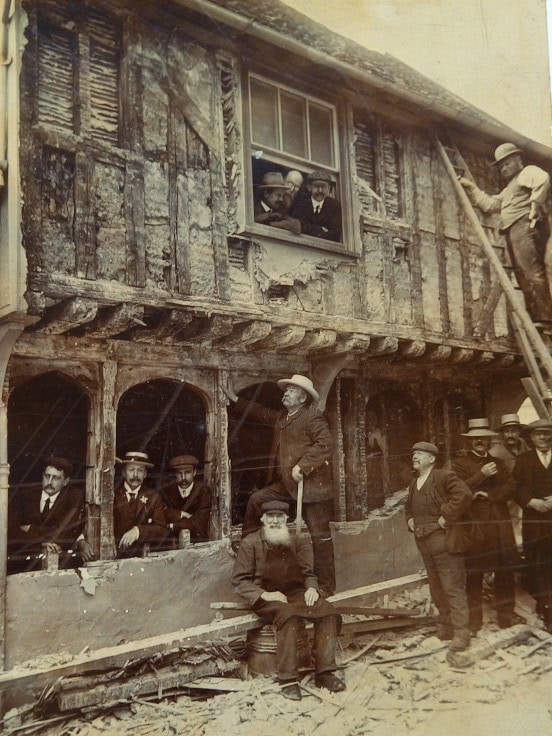
17 19 21 King Street is a jettied medieval house in the town centre, now shops. It has a freehand stamped pattern on the first and 2nd floor. In the Stacey album is an image taken when it was stripped down by the builder Benjamin Dix in 1913 and presumably the cement based patterning was part of the subsequent repair.
12 Bridge Street
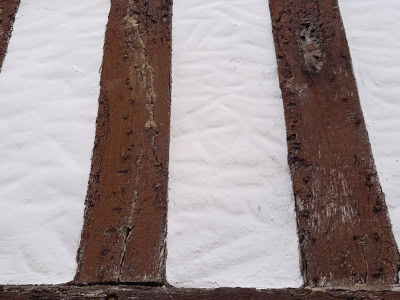
An old timber frame building has been lined out in panels. A flush bead border moulding surrounds a stamped fan pattern which was never very deep and has since become obscured by layers of paint. Typical seventeenth century panels would have been rectangular but to the bottom left it can be seen that these panels step around the door head. The panels are not perfectly squared which by the nineteenth century is rather shoddy workmanship.
27 Hill Street
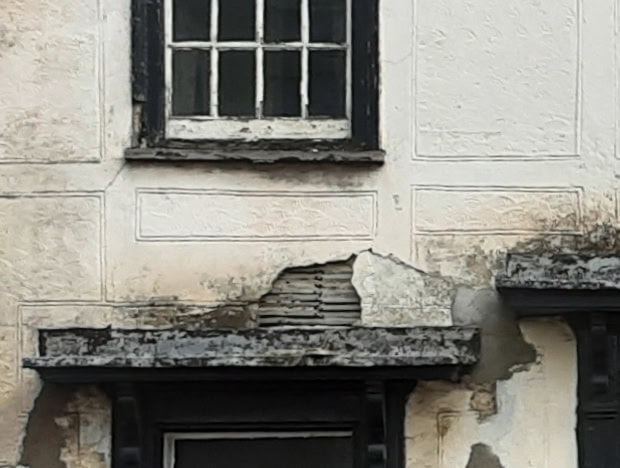
27 Hill Street is prominently located on a road junction. It could have been pargeted at any time between the 1884 grant of patent for the expanded metal mesh onto which it is plastered[1] through to the 1955 Stacey picture showing it as now. Stylistically it is Arts and Crafts with flush bead border and stamped fans.
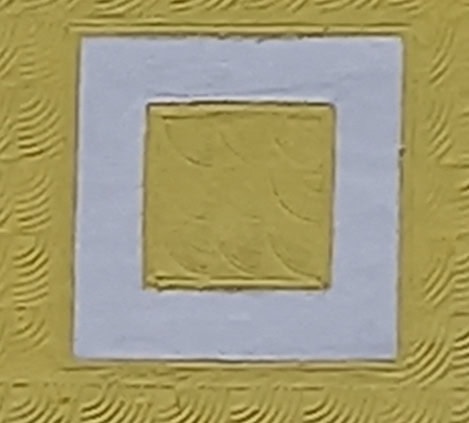
Several fans were used, they were used at a range of angles and each panel is stamped in a repeating manner but the stamp was incorrectly shaped to cover the surface completely. The pargeter either did not understand, or perhaps ignored the traditional use of the fan pattern with interlocking fans and instead he left blank areas which can clearly be seen in figure 9. Between the upper windows is a 400mm square panel which looks as if was designed to display something more interesting than the faint fans which it actually contains. The workmanship is adequate though it varies somewhat in depth and the edge finishing is not always the best.


26, 28 and 30 Castle Street
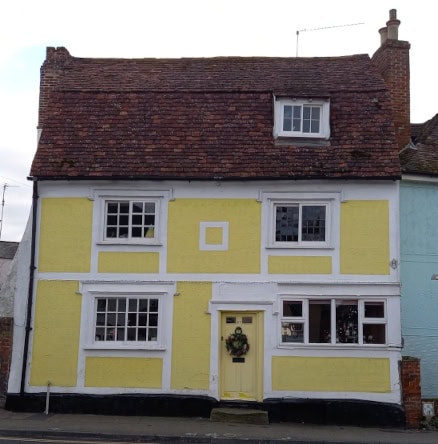
The simple, deeply carved stamp is more reminiscent of good recent pargeting but 26, 28 and 30 Castle Street were already pargeted by 1914 with a repeating fan in narrow border. (figure 11). The pargeting does not appear to have changed since that date and a close up image (figure 12) shows the good quality of the stamp work, evenly laid out, of consistent depth and continuing all the way to the border edge.


20 Bridge Street
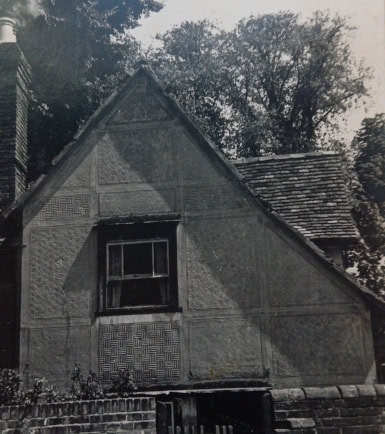
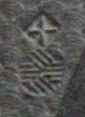
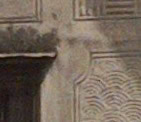
20 Bridge street no longer exists. The design beneath the cross is unique in Saffron Walden. There was also a flower stamp but the image resolution of figure 24 is not good enough to see if it was modelled with a stamp borrowed from the Arts and Crafts Terraces. The curved border around the window head is nineteenth century or later.
Other buildings
Several other buildings have parget traces which conform to the Arts and Crafts style, but are so simple, damaged or overpainted, that not much can be said about them.
| 10 Market Hill | Flush bead and probably a stamped fan, Well modelled originally. |
| 11, 13, 15 Museum street | Trace of flush bead with no infill on gable end. |
| 20A 22 King Street | Flush bead and stamped fan. Stamped irregularly but tidy to the edges. |
| Harnser, Little Walden | The side wall. Tidy stamped fan, narrow border. |
| 24 26 Bridge Street | L shaped panels, each panel containing repeating stamps. Flush bead. Small basket weave and horizontal chevron both tidily pargeted and a combed fan which is a difficult pattern to achieve and this example is not good. Many later repairs. |
| 13A and 15 King Street | Combed fan in flush bead. |
Markers of Arts and Crafts parget
- Stamped and sometimes combed work, no freehand in Saffron Walden
- Some workmanship is good, some very poor
- One panel covered using one stamp repeatedly, the next panel covered using another.
- Plaster made of sand and cement
- Border is a flush bead
- Generally good definition
[1] Wikipedia contributors, ‘Expanded metal’, 19 October 2022, https://en.wikipedia.org/w/index.php?title=Expanded_metal&oldid=1116979201 [accessed 4 May 2023]