
The Arts and Crafts movement flourished in Europe and North America between about 1880 and 1920. It was initiated in reaction against the perceived impoverishment of the decorative arts and the conditions in which they were produced.[1] Plasterwork is a clear example of a trade which had once included the decorative creation of freehand pargeting and stucco, but which had become deskilled.
In the Saffron Walden area the Arts and Crafts revival started in 1869, which is earlier than the accepted start of the Arts and Crafts period. The momentum came from two patrons and one architect, namely Frederick Bullock the Rector of Radwinter, Saffron Walden businessman George Stacey Gibson and the architect William Eden Nesfield.
Table of Contents
William Eden Nesfield
William Eden Nesfield was a cutting edge architect, being one of the first people to embrace the ethos of arts and crafts. He is not well known today because he was not hungry for fame and with family money he was able to retire from his architectural practice in midlife and devote himself to art.
He was the eldest son of a successful landscape gardener who in the 1840s and 1850s reorganised some of the largest country house gardens in the country. William Eden Nesfield depended on his father for early commissions and connections but he was no mere echo of his father and was an exceptional designer and draughtsman and he was particularly noted for the detail and ornament of his buildings.[2]
A close architect friend was (Richard) Norman Shaw and they began as devotees of the Gothic Revival but in 1862 on a walking holiday in Sussex and Kent they were delighted by the charm of traditional English timber architecture and the next year Nesfield built a lodge in Regents Park followed by other small houses and cottages in what became called the “Old English” style. Nesfield loved to add things like ornamental leadwork, stained glass, plasterwork and carved brickwork and he went to the best craftsmen that he could find. Nesfield had worked in East Anglia since the 1850s and was particularly interested in the decorative potential of pargeting.[3]
Rose and Crown Hotel
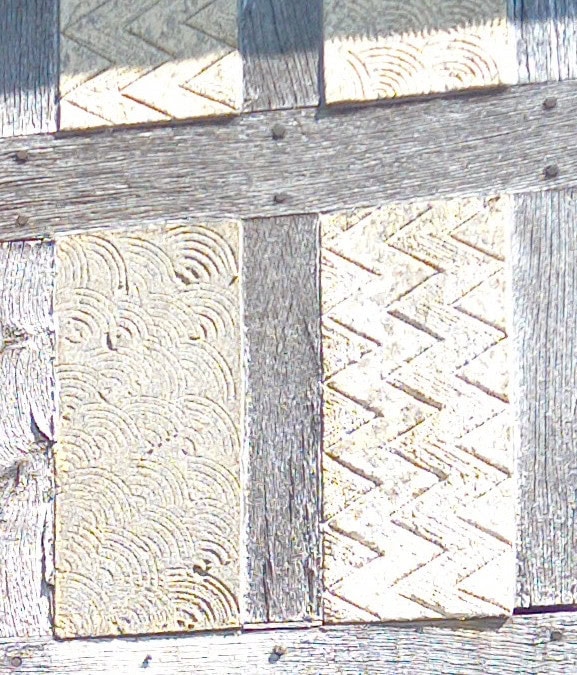
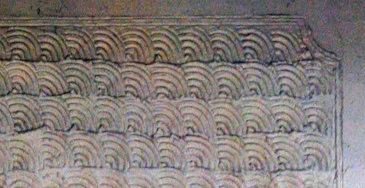
In 1868 Frederick Bullock, Rector of Radwinter invited Nesfield to remodel Radwinter Church five miles from Saffron Walden and Nesfield introduced a porch pargeted with combed work in sand cement render. Shadows can be seen at the bottom of the panels where they now stick out as the timber frame has dried, twisted and shrunk. Some of the panels have cracked, broken and been replaced. A seventeenth century craftsman would have avoided these problems by waiting a year or so for the timber frame to settle and by using lime/chalk/hair plaster. Probably a local flatwork plasterer was asked to do the work and he was inexperienced in doing parget. A better or more experienced pargeter would have used a comb which repeated exactly three times in each panel and they would have combed perfectly horizontal rows.
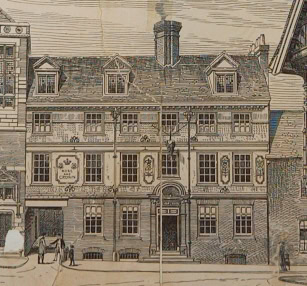
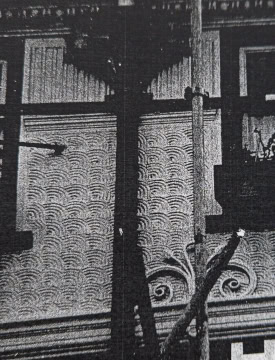
The work on Radwinter church led to Nesfield building Gibson’s new Bank in Saffron Walden Market Place in 1874[4] and at the same time he redesigned the front of the Rose and Crown Hotel on the Market Place and he included pargeting on the front elevation of the Rose and Crown.
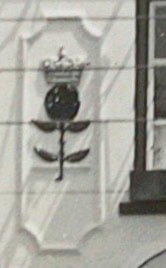
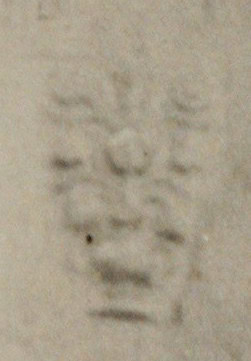
Close up photos were taken a few years later when a sign was installed. The fan appears to be combed and the pargeting is of better quality than that on the Radwinter church porch. The vertical ornament is cast as are the Rose and Crown motifs. As an aside, on the rear of the Rose and Crown was an isolated motif which could be a remnant of seventeenth century decoration. The Rose and Crown burned down in 1969 and the site was completely redeveloped.

Radwinter village
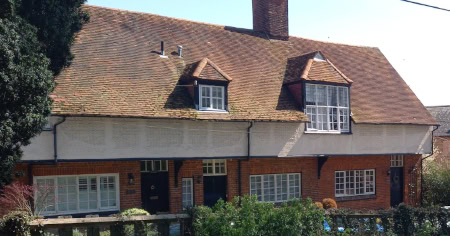
In 1874, a fire destroyed the centre of Radwinter village and when Nesfield designed replacement houses he included pargeting in the design, though he called it ‘combed plaster’ rather than parget. The builder chosen to do the work was Whiffin (mentioned earlier) who presumably employed a pargeter to do the actual work though there is no reference to this.[5]
The work was tidily done, but again sand/cement was used and it has partly failed and been replaced twice.
Pargeted border
A typical border to a pargeted panel had been a simple incised line in the seventeenth century, but the border of the Radwinter church cottage pargets is formed from a pair of incised lines, which might be the pargeter’s interpretation of a drawn instruction from Nesfield to create a flush bead border. From this time onwards, it has become usual practice to give a flush bead border to a parget panel.

Documentation
Letters still exist[6] from Nesfield to Reverend Bullock about remodelling the Church and from Nesfield to Gibson about building the Bank. The Bank letters also mention the Rose and Crown, the remodelling of which seems to have been happening in tandem with building the bank. These letters mention the various local builders who tendered and worked on the projects. Large local firm Bell remodelled the church and Nesfield was very particular that they should use red plastering sand to give the walls a warm colour and that the roof should be smooth and the walls rough. The work was not done to his satisfaction and Bell had to re-do some of it. Whiffin did some brickwork and supplied oak for the church and was responsible for all of the cottage building. A London firm called Macey won the bank contract, but some bricklaying and joinery was subcontracted to local company Whiffin. Some desks for the bank were built by local company Dix.
Conclusion
The parget on the Radwinter Church, the Saffron Walden Rose and Crown and the Radwinter Cottages are early examples of the Arts and Crafts revival of pargeting. At about the same time George Stacey Gibson commissioned the repair and renovation of the Old Sun Inn in Saffron Walden which already had some important seventeenth century pargeting. Nesfield was not directly involved in this work as he does not mention it in his letters, but there must have been some cross fertilisation of ideas and probably tradesmen.
This is an appropriate point to look in detail at the Old Sun Inn, which contains both important seventeenth century pargeting and early arts and crafts pargeting.
[1] Brenda M. King, Silk and Empire, Studies in Imperialism (Manchester University Press ; Distributed exclusively in the USA by Palgrave, 2005).
[2] W. Eden Nesfield and J. F. W. Bullock, A Deuce of an Uproar: William Eden Nesfield’s Letters to the Rector of Radwinter in Essex (Friends of Radwinter Church, 1988).
[3] Shirley Rose Evans, Masters of Their Craft: The Art, Architecture and Garden Design of the Nesfields (Cambridge: Lutterworth Press, 2014).
[4] Bruce Munro, One Man’s Saffron Walden Munro (SWHS Publications, 2023).
[5] Nesfield and Bullock, A Deuce of an Uproar.
[6] Nesfield and Bullock, A Deuce of an Uproar.