
Table of Contents
Whiffin
The Whiffin family of bricklaying builders continued into another generation. George Whiffin and Sons builder and contractor was based in Station Road and Debden Road in 1882[1] George died in 1883 but the business was continued by sons Frederick James (1848 -1895) who lived in South Road[2] and Alfred Henry (1850-1903) who lived in Gold Street.[3] They built the Radwinter houses, did work on Radwinter church and Gibson’s bank for Nesfield and also built 8-16 King Street.
Richard Dix
In the 1870s three carpenter/joiner brothers arrived in Saffron Walden from Steeple Bumpstead. The oldest and the most entrepreneurial was Richard (Dick) Dix, who had previously worked as a builder in Chicago until the fire of 1871. Dick Dix built many houses around Saffron Walden and it is probable that he was responsible for all the Arts and Crafts Terraces, as he certainly built two of them, Artisans Dwellings and 8 Mount Pleasant.
Cement Factory
In a mostly chalk district Dick Dix found a seam of clay along a lane off the Thaxted road and decided to open a cement factory in 1879[4] which eventually employed about 200 people. The clay was brought by private railway to a kiln near the Thaxted road. the rocks were then taken to a crushing mill in West Road and loaded onto railway trucks (Saffron Walden was on a branch line).[5] As an experiment in the use of cement Dick Dix built Artisans Dwellings, a row of small pargeted houses which he rented to people who worked in the cement works. With such a ready supply of local cement it is likely that all the Arts and Crafts parget was cement based and where the plaster can be clearly seen on the buildings, it certainly appears to be.
The business continued after Dick Dix died in 1900 as two of his sons Joseph and Andrew were partners in the cement works and in “Dick Dix and Sons Builders and Contractors”[6] When to Dick Dix’s disgust the main railway line was not routed through Saffron Walden, the cement works were sold and “Dick Dix and Sons” concentrated on building contracts.
Benjamin Dix
Dick Dix’s brother Benjamin Dix also ran a building business but his business focused more on restoration. He restored many old buildings especially in King Street removing plaster and probably parget to reveal oak beams, such as No. 21 King Street which he renovated in 1913, reinstating the plaster with cement based mortar and a textured finish.
One of the Dix family of builders specialised in creating ornamental barge boards of which there are several 19th century examples around town, including on many of the Arts and Crafts Terraces.[7]
Bell and Company
The prestigious Bell family of builders continued in Saffron Walden into the fourth generation with Joseph Bell the younger and the fifth generation with William Charles George Bell (1859-1936).
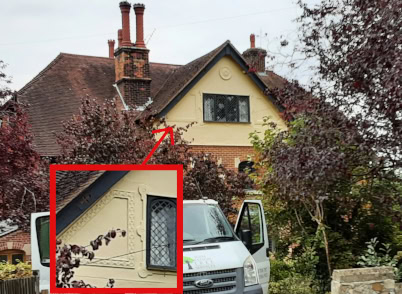
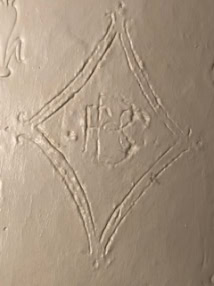
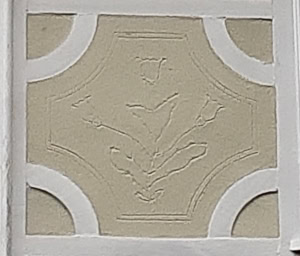
Joseph Bell the younger built 9-17 Mount Pleasant between about 1884 and 1887[8], some as red brick villas, some with stone cladding and tile hanging. His son William Charles George Bell’s house was 11 Mount Pleasant and was occupied by 1901.[9] It has ornamental plasterwork on the front facing gable and it is said that it used to have a rose where the roundel is now. The panels each side of the upper windows are cast and planted. Inside the entrance hall is a series of name and date panels (figure 2) which might have been scratched out by the same workman who did the floral motifs for Dick Dix on No 8 Mount Pleasant (figure 3).
The interest of this house is not the quality of the parget but as a demonstration of the appreciation of pargeting shown by the proprietor of a large building company by putting it on his own house.
Advertising literature for Bell and Company reveals that they constructed many prestigious buildings around the country[10] In Saffron Walden this included houses in Mount Pleasant Road, High Street, Audley Road, South Road and Borough Lane, twelve cottages on Thaxted Road and twelve cottages on Victoria Avenue in a concrete block for Miss M.W. Gibson (daughter of George Stacey Gibson), four bungalows in Victoria Gardens, additions to The Close, Capital and Counties Bank, London and County Bank, various mills and maltings, shops in King Street and numerous shop fronts. This list does not correspond with any of the Arts and Crafts Terraces.
Erswell
The Erswell building business also continued into the next generation. Francis Willis Erswell was in 1862 a builder and undertaker.[11] In 1871 his building business was based in Saffron Walden Market[12] so perhaps he was working on site when he is seen in 1881[13] six miles away in Water End, Ashdon, which presumably was considered too far to travel each day. By 1881 he had died and his widow Rosetta was running the building business.[14] followed by son Edgar William in 1895.[15]
Wright
Thomas Wright was 46 in 1861[16], a builder employing twelve men and two boys, by 1871[17] he employed twenty eight men and three boys. He was still a builder in 1881[18] and retired by 1891[19].
The pargeters
By the late nineteenth century, the larger building companies are easy to spot, but the pargeters are still hidden.
In the 1881[20] census there were only three plasterers in Saffron Walden and none of them were local men. John Bradley (aged 45) with brothers Stephen Tingey (20) and Joseph Tingey (24) all lived in Cambridge and were lodged temporarily in Saffron Walden. It is likely that they had a specialist skill which was probably interior stucco work. At this time Cambridge was the local centre for high quality plasterwork, as a wider census search for plasterers in north Essex, Cambridgeshire, Suffolk and Hertfordshire found few except in Cambridge where there were 52, including 24 who were born elsewhere and one nine man plastering company. The father of Stephen and Joseph was also a plasterer and it seems that Cambridge was a centre for the apprenticeship and training of plasterers.
There must also have been local workers who could plaster competently in Saffron Walden because many new houses were being built and the interior walls were all plastered, so presumably the plasterers gave themselves another trade in the 1881 census. To find the Arts and Crafts pargeters it is necessary to look either for someone who lived outside Saffron Walden or for a building worker who pargeted as an adjunct to their main skill set.
There is not an enormous quantity of Arts and Crafts pargeting in Saffron Walden and one pargeter could physically have done all of the work, but the Artisans dwellings and 39 to 45 West Road are clearly better designed than the other pargeting so either there was more than one pargeter or the one pargeter was closely directed by a designer or architect.
Dave Lewis, retired pargeter, mentioned a Victorian pargeter called John Plume who worked in Saffron Walden but was dead before Dave was born. Investigation found that John Plume was born near Hoddesdon, Herts in 1834 and lived in that area all of his life. Hoddesdon is 31 miles from Saffron Walden. In 1881[21] aged 47 he was a plasterer and in 1901[22] aged 67 he was employed as a terracotta modeller, a trade closely related to pargeting when it is likely that he was working for Pulham & Son (of Pulhamite fame) who were based in Hoddesdon.[23] There is no direct evidence that John Plume is the mystery pargeter, but he does fit the profile. Unfortunately, a Google Maps trawl of Hoddesdon High Street found a few examples of stamped pargeting but nothing using the distinctive set of stamps seen on the Saffron Walden terraces.
In conclusion, the Saffron Walden Arts and Crafts pargeters are elusive, but it seems likely that the person who pargeted the Arts and Crafts Terraces was among the employees of Richard Dix.
[1] Kelly 1882
[2] ‘Census Returns of England and Wales, 1881’
[3] ‘Census Returns of England and Wales, 1881’
[4] ‘Cement Kilns: Saffron Walden’ <https://cementkilns.co.uk/cement_kiln_saffron_walden.html> [accessed 21 January 2025].
[5] Gillian Holman, Violet Dix’s Trunk: Childhood in Saffron Walden, 1910-1920 (Ian Henry, 1996).
[6] Kelly, 1895 Kelly’s Directory (London: Kelly, 1895)
[7] Bruce Tice, pers. comm. about the history of Saffron Walden, 2022.
[8] Gillian Williamson, ‘Mount Pleasant Houses—Unpublished Document’, 2020.
[9] Williamson, ‘Mount Pleasant Houses—Unpublished Document’.
[10] Bell, William
[11] Kelly ed., 1862
[12] Kelly ed., 1871
[13] ‘Census Returns of England and Wales, 1881’ (HM Government, 1881), The National Archives, Kew.
[14] ‘Census Returns of England and Wales, 1881’
[15] Kelly’s Directory 1895, ed. by Kelly & Co. Ltd (Kelly & Co Ltd, 1895). 1895
[16] ‘Census Returns of England and Wales, 1861’ (HM Government, 1861), The National Archives, Kew.
[17] ‘Census Returns of England and Wales, 1871’ (HM Government, 1871), The National Archives, Kew.
[18] ‘Census Returns of England and Wales, 1881’.
[19] ‘Census Returns of England and Wales, 1891’ (HM Government, 1891), The National Archives, Kew.
[20] ‘Census Returns of England and Wales, 1881’.
[21] ‘Census Returns of England and Wales, 1881’.
[22] ‘Census Returns of England and Wales, 1901’ (HM Government, 1901), The National Archives, Kew.
[23] Pulham Legacy 2018 https://pulham.org.uk [accessed 4 May 2023]