
Pargeting describes a vernacular trade so there is no universally acknowledged definition of its use. The word ‘pargeting’ is a verb and a noun each with a variety of spellings, its meaning has changed over time, other words are sometimes used for the same skill set and the word can be used figuratively, so it is helpful at the outset to clarify what pargeting is, and what it is not.
The origin of the term pargeting is obscure. The Oxford English Dictionary lists various spellings of the word parget. It can be used as a noun, verb or adjective and can refer to the product or the person doing the work. The most frequently used versions are parge, parget, pargeting and pargetting. Many references from the earliest c1380 to the latest in 1789 refer to flatwork plaster rather than to ornamental, to the extent that unless it is clear that ornamental parget is meant, it is prudent to assume that it is not. The first clear example in the Oxford English Dictionary of the use of parget to describe exterior ornamental plasterwork is in 1661. Other uses of the word in the Oxford English Dictionary which are ignored in this research describe coating the inside of a chimney, limewashing, figurative use for cleanliness or smoothing over, decorating a surface with some other material and any modern usage since 1945.
Table of Contents
The literature
The literature on pargeting is limited and mostly descriptive, however the architect Tim Buxbaum has written a good overview which contains a useful bibliography[1] and Essex County Council[2] and Babergh District Council Planning department[3] have both produced leaflets on good practice. Writing by practitioners is rare but valuable. Important early 20th century practitioners were Millar who discusses pargeting briefly in the fourth edition of his seminal tome Plastering Plain and Decorative,[4] and Bankart who writes about it in more depth in ‘The Art of the Plasterer’.[5] Fred Willett was a mid 20th century practitioner who contributed a useful article to Bygones 5.[6] Claire Gapper has researched the stucco of Audley End in the parish of Saffron Walden.[7] The ornamental plaster at Audley End is more polite than the parget of this research, but it may have provided inspiration for local pargeters. Nineteenth and early twentieth century antiquarians Corrie[8], Piggott[9] and Laver[10] wrote articles which discussed parget which today may be lost, but they do not engage with the pargeters themselves. Basil Oliver[11] took some excellent photos which reveal how much even ‘original’ parget may have changed over the years. The more ornate parget designs may have been taken from pattern books though no obvious example of this has been found in Saffron Walden. Historic England mentions parget only briefly in ‘Practical Building Conservation’.[12]
As the literature which engages with pargeting is extremely limited, the buildings themselves, personal understanding of the pargeting trade and current local knowledge are important.
Materials and tools used until the early 19th century
In East Anglia the normal material used to plaster timber framed houses was a mixture of chalk, lime putty and plenty of hair. After falling out of use in the 19th century, within the last twenty years the advantage of this mix has again been realised and it is often specified today for the conservation of timber framed buildings as it sets to a mat-like material that gently moves as the timber frame flexes with the seasons.
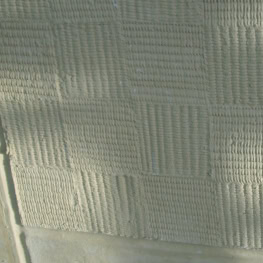
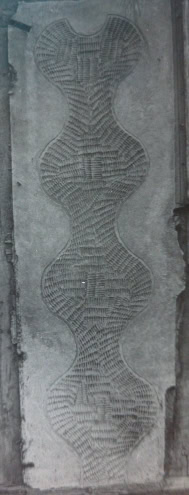
A further coat of this plaster mix was used for combed or stamped pargeting patterns modelled in a variety of traditional designs. The most frequent patterns were stippling, wool skein, fan, basket weave and chevron all originally made using a comb of whittled twigs, now more likely to be made using a comb of dowel. Combed pargeting produces an interestingly textured finish and would have been in the skill set of all plasterers when it was a popular finish because competent plasterers can learn the basic techniques within a day. With a plasterer laying on the plaster onto the wall and a pargeter following on to comb the wet surface, a wall can be completed in twice the time that a plain flat wall would take, so it was not a particularly expensive finish. The combing was usually contained within rectangular frames marked into the plaster between the windows and perhaps between the storeys. They regularise the elevation and provide a neat break point for the plasterer at the end of a sequence of work.



Moulded motifs
Some parget motifs are moulded on the bench and then planted onto the surface. Traditionally the mould would be carved out of timber (figure 6) and it is said that in the past the carving was done by a specialist, though no reference to this can be found and pargeters today will do their own carving.
Lime plaster was dried to leather hardness and then beaten into the mould[13]. Before it was completely set, it was dis-moulded and attached to the elevation with wet lime plaster, perhaps with a nail as added support. As the motif was not completely set when it was mounted, the pargeter had the opportunity to tweak each cast as it is planted on the wall, Figure 7 shows an example where the three cast leaves have been individually curved around the bunch of grapes, so introducing a variety of detail.
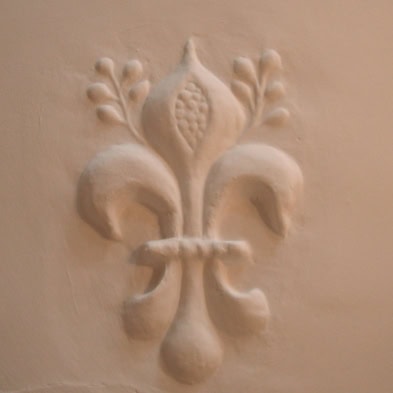
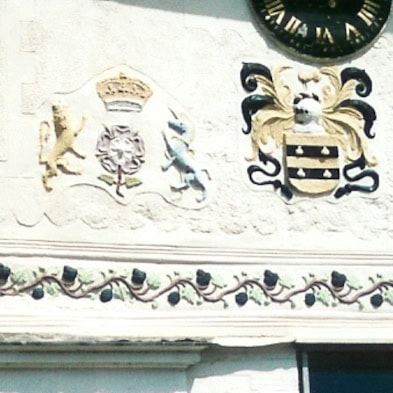
Popular cast motifs were fleur de lys (figure 8), crests, roses and vegetal friezes (figure 9). Having looked at many seventeenth century cast motifs it is interesting how rarely they repeat. There is considerable overhead in making a wooden mould which the pargeter would then want to use repeatedly, so the scarcity of repeat patterns can only be because very much pargeting has been lost over the years.


Raised panels
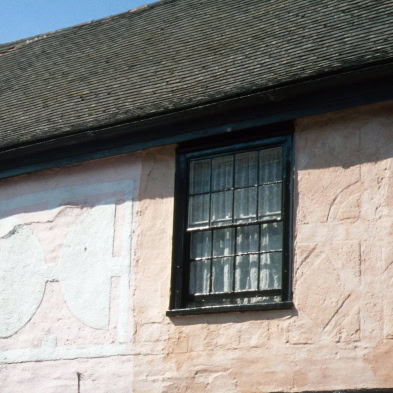
Figure 10 is an example of a raised panel style which was popular in the seventeenth century and may have remained fashionable into the eighteenth century after the more elaborate designs went out of use. It is not clear when the use of raised panels declined, but they are not a feature of Arts and Crafts pargeting. Being simple in design they are difficult to date, a perennial problem when trying to understand the development of pargeting because there is nothing intrinsic in plaster which can give precise dates in the way that tree ring dating can do for oak. Date or name panels can be helpful, as can adjacent datable features, such as an inserted window which interrupts older parget or such as an extension to the building which traps old parget indoors.
Freehand modelling
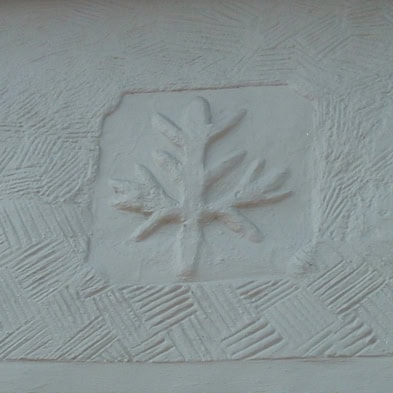
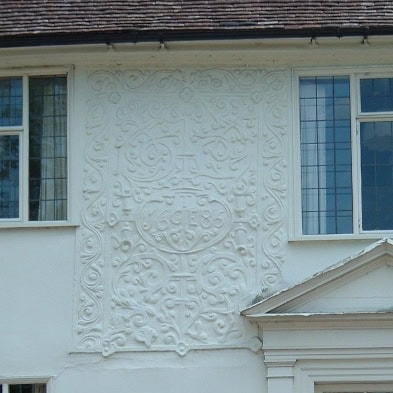
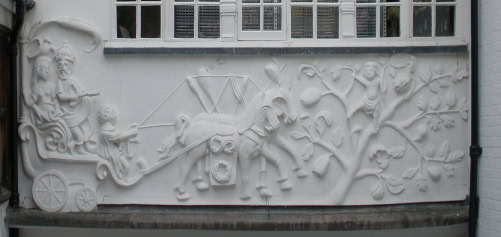
Freehand modelling varies widely. In the seventeenth century it ranged from simple motifs such as figure 11 which many plasterers might be able do, to elegant patterning such as in figures 12 and 13 which require the craft skill of a plasterer and the design skill of an artist so one imagines that there was always a limited group of people who undertook these more complex pargets. Figure 14 is particularly elaborate work.
The traditional chalk, lime putty and hair mix is ideal for freehand work, being somewhat like clay in consistency. After an absence of two hundred years, during the last thirty years freehand modelling has once again come into fashion.

Materials and tools used from the late 19th century
By the late 19th century the normal material used for plastering was a sand and lime putty mix, with hair added to the mix on timber frame buildings. As cement became more widely available a sand and cement mix then became usual.
These sandy mixes were much less sticky than the earlier chalk mixes and a stamp releases more easily from the surface, so when pargeting became popular again as part of the Arts and Crafts movement the patterns were mostly stamped or fully set cast motifs were planted on the wall and the seventeenth century techniques of combing and freehand modelling were rare. The fan and basket weave are examples of designs which earlier would have been combed but in the late 19th century were stamped. The range of stamped designs is wide, with stylised flowers being popular.


The origins of pargeting
The precursor of pargeting is modelled stucco and 1500BCE bull and human heads at Knossos are early examples of this.[14] Roman stucco provides a more direct connection to England via the Renaissance rediscovery of the Domus Aurea, Nero’s Golden Palace. Giovanni da Udine was an assistant of the artist Raphael who specialised in stucco modelling, teaching himself the skills needed to recreate the stucco which was found in the Domus Aurea and using his skills to ornament the palace of Pope Leo X in 1513. Stucco rapidly became a high fashion item desired by princes and kings and it arrived in England when Henry VIII employed the Italian Nicholas Bellin of Modena to lavishly decorate several of his palaces including Nonsuch.[15] Much of the exterior and the inner and courtyard walls of Nonsuch Palace were decorated in extremely good quality stucco standing at least 150mm in high relief and there are remains of this stucco in the Museum of London. Nicholas Bellin worked in carved and gilded slate but he must also have overseen the stucco work which included human and animal figures, fruit and flowers, swags, trophies, architectural details and royal badges. The Nonsuch accounts mention several stuccoists, some with English names, so the skills were already being learned by artistically inclined English plasterers and from this time stucco decoration flourished in England. There are many examples of ornamental plaster ceilings and overmantels in grand country houses and many more in smaller houses which tend to be less comprehensively documented though one exception is an excellent review of the decorative plasterwork of Somerset between 1500 and 1700 by John and Jane Penoyre, which catalogues plaques, friezes, overmantels and ceilings which were modelled in lime plaster by native plasterers in a style which is distinctively English and closely related to pargeting.[16]
History of pargeting
Today, the area of England where seventeenth century parget is most frequently seen is Suffolk, north Essex and the adjacent areas of Hertfordshire and Cambridgeshire. Pargeting became popular as timber framed buildings fell from fashion and were replaced by stone buildings in the sixteenth and seventeenth centuries. In the areas where seventeenth century parget is most seen today there is no good building stone, chalk was close to the surface, and widely dispersed medieval wealth meant that there were many good quality timber framed houses which might be improved rather than replaced and this combination of factors provided the ideal circumstance for pargeting to flourish as the timber frame could be covered with plaster made from chalk, lime putty and hair and then the flat surface could be decorated with parget to make it interesting.
Seventeenth century parget is also still to be seen in many other parts of the country, such as The Salisbury Arms, Hertford and Queen Elizabeth’s Guest House, Canterbury, but outside the core area, pargeted buildings are few in number and are decorated with the highest quality elaborate parget. One can speculate that simpler parget has been less valued and so was removed during the intervening years and that the Industrial Revolution was a likely time for this to have happened as the introduction of brick, good transportation and changing fashion meant that pargeted buildings were re-faced or entirely replaced throughout much of the country. Having been one of the wealthiest parts of the country in Medieval and Tudor periods the core area where seventeenth century parget is seen today became one of the poorest parts of the country and there was not the money for so much change, old parget remained and basic pargeting skills may have never died out completely. This is a plausible scenario, but there is as yet no clear causal connection and further research is needed to establish the true situation.
Having been unfashionable for 180 years, parget resurfaced as part of the Arts and Crafts revival and since then has never completely gone out of fashion.
What is not pargeting?
There are several associated trades and skill sets which can be differentiated from pargeting. ‘Stucco’ is the Italian word for the similar set of techniques seen on the ceilings and overmantels of grand sixteenth to eighteenth century houses. Compared to parget, stucco work is of exceptional quality and complexity and may contain additional materials such as glue. In comparison with vernacular pargeting it has been well researched.[17] It is probable that stucco provided the inspiration for freehand pargeting.
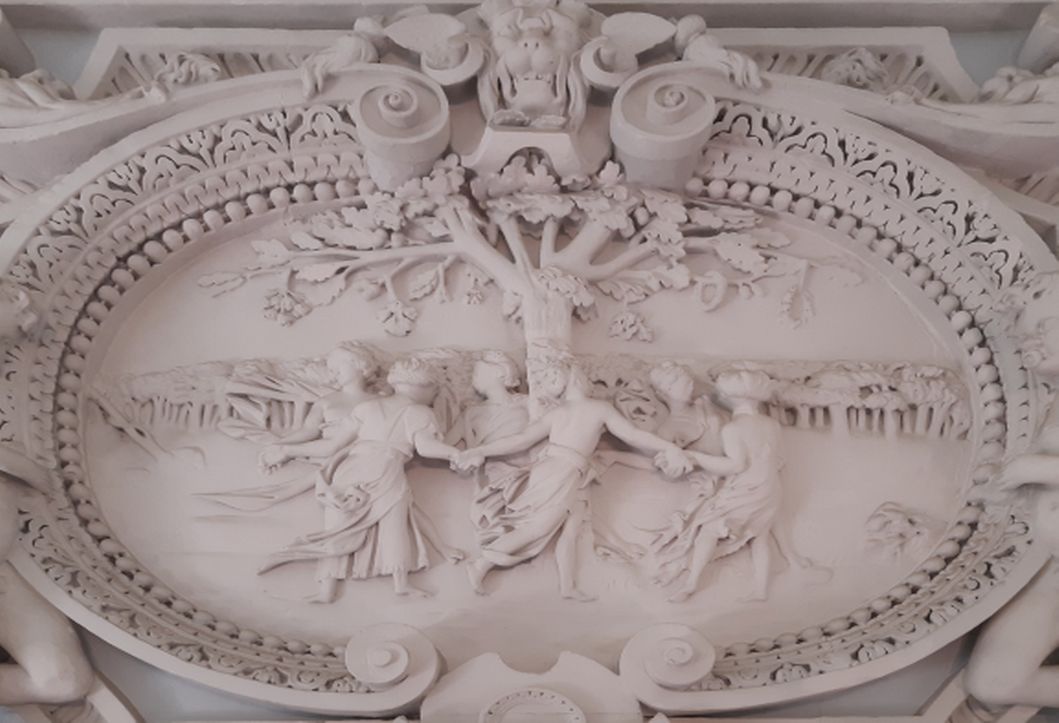
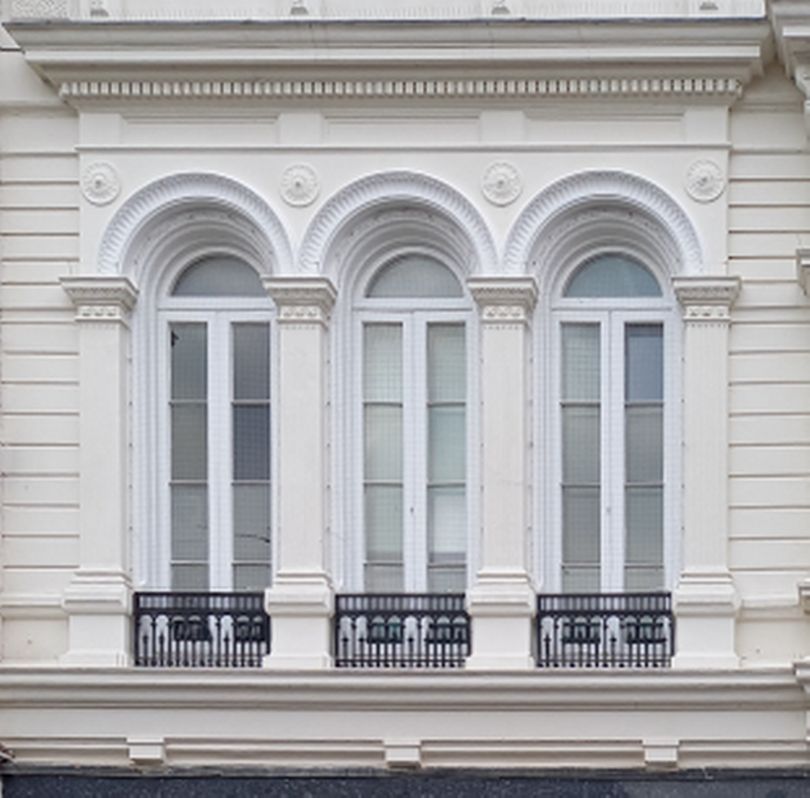
Also called stucco is formal Italianate plasterwork of the nineteenth century which references classical designs and motifs. It is much more precise in its proportions.
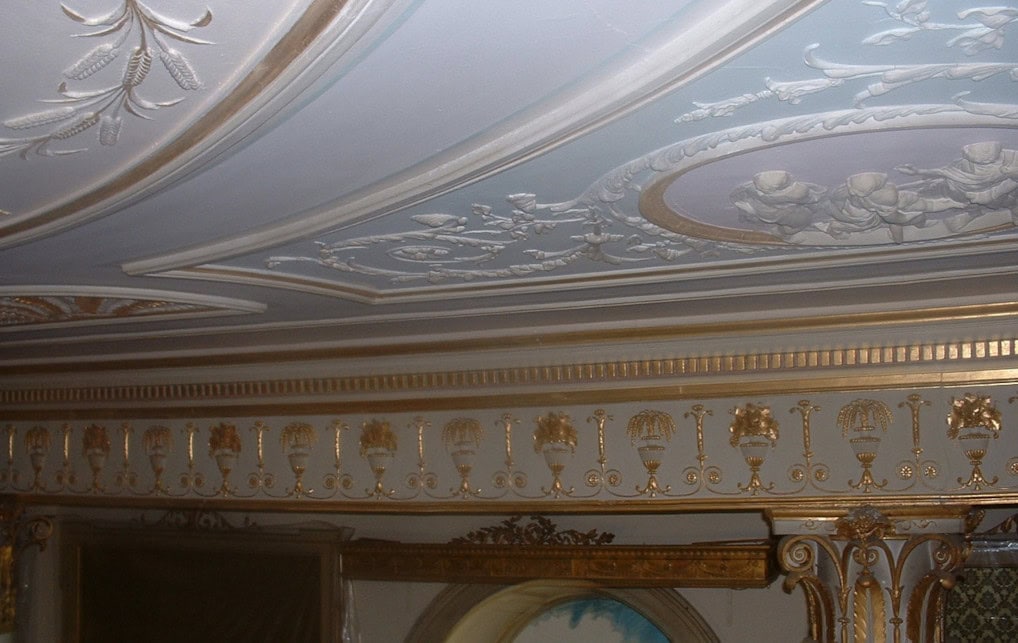
Ornamental gypsum plasterwork such as ceiling roses and filigree ceiling ornament was popularised by Robert Adam and it is always located indoors as gypsum is not weatherproof. Gypsum plaster is cast into moulds and when it is completely set it is planted onto the ceiling. The introduction of gypsum ornament de-skilled the plastering trade, so today most plastering work is only to cover flat surfaces, perhaps with the addition of pre-moulded features like cornice. Today, very few plasterers are able to plaster curved shapes or do freehand modelling.
Sometimes external plastered walls are given a simple brushed finish or simple framed panels are added. Twentieth and twenty-first century examples of this are so ubiquitous in Essex that they have been omitted from this study, though a few earlier examples of simple framing have been included.

There is one final category of plasterwork which could be called parget, namely interior vernacular lime plasterwork as described by Penoyre[18]. It is closely related to parget and typically includes cast, run and hand modelled work but not combed work and there is one OED reference where rustic internal work is called pargeting. It was probably produced by the same craftsmen, perhaps during the winter when exterior work was not possible, but has been excluded from this study for two reasons. One reason is that being hidden indoors it is not easy to be confident that a meaningful sample has been surveyed and the other reason is that there is not a clear boundary between this and the stucco of Figure 17.
Comparison of wall painting
Secular wall painting is a form of decoration, often designed to imitate tapestry, which was popular in the sixteenth and seventeenth century and a house owned by the middling classes might have wall painting on the interior walls and pargeting on the exterior walls.[19] The Close in Saffron Walden is an example which contained both wall painting inside[20] and pargeting outside.

Discussing a (now lost) wall painting from Sewards End, a hamlet just outside Saffron Walden, the antiquaries Christie and Maynard[21] noted that the designs were freehand without exact symmetry, and this is also a feature of seventeenth century pargeting. They described conventionalised foliage and flowers and gave a sample to Saffron Walden Museum.
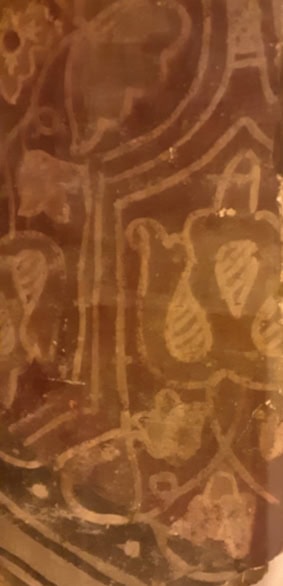
Pargeting was normally coloured in monochrome with plain limewash, white or lightly tinted, sometimes outlined with a thin line of a dark earth coloured paint for emphasis. Wall painting could also be monochrome but is more likely than parget to be multi coloured, perhaps because being indoors it was protected from the weather.
[1] Tim Buxbaum, Pargeting, Shire Album, 341 (Princes Risborough: Shire, 1999).
[2] D F Stenning and P M Richards, Traditional Building Materials in Essex. No. 1, Pargetting (Chelmsford: Essex County Council, 1982).
[3] J K Preston Pargetting in Babergh. A Planning Authority and the Future of Vernacular Decoration, Essex Record Office LIB/693.6 PRE
[4] William Millar, Plastering Plain & Decorative, 4th edn (London: B T Batsford, 1927), pp. 81–82.
[5] George P. Bankart, The Art of the Plasterer, 2nd edition (London: B. T. Batsford, c1910) repr (Shaftesbury: Donhead, 2002)
[6] Fred Willetts, ‘Pargetting’, in Bygones 5, ed. by Joice, Dick (Woodbridge: Boydell Press, 1980).
[7] Gapper, Claire, ‘Plasterers and Plasterwork in City, Court and County c.1530-c.1640. Unpublished PhD’ (Courtauld Institute of Art, 1998) http://clairegapper.info/ [accessed 4 May 2023]
[8] E.S. Corrie, ‘On Pargeting’, Transactions of the Essex Archaeological Society, Second series, 3 (1889) 201-206
[9] John Piggott, ‘Notes on “Pargetting”’, Transactions of the Essex Archaeological Society, 5 (1873) 73-78
[10] H Laver, ‘Pargetting’, Transactions of Essex Archaeological Society, 10 (1909) 73-78
[11] Basil Oliver, Old Houses and Village Buildings in East Anglia (London: B.T. Batsford, 1912).
[12] English Heritage, ed., Practical Building Conservation: Mortars, Renders & Plasters (Farnham: Ashgate, 2011)
[13] Stafford Holmes and Michael Wingate, Building with Lime: A Practical Introduction (London: Intermediate Technology, 1997), p. 138.
[14] Bankart.
[15] M Biddle, ‘Nicholas Bellin of Modena’, Journal of the British Archaeological Association, (1966) 106-121
[16] John Penoyre and Jane Penoyre, Decorative Plasterwork in the Houses of Somerset 1500-1700 (Taunton: Somerset County Council, 1994).
[17] Gapper, Claire
[18] John Penoyre and Jane Penoyre
[19] Miller Christy and Guy Maynard, ‘Early Domestic Wall Paintings Recently Found in Essex’, Transactions of Essex Archaeological Society, Transactions 12 (1913) 23-37
[20] Francis W. Reader, Drawing of a Wall Painting in The Close, Saffron Walden, ECC20, pen and ink, London, Victoria and Albert Museum, Prints and Drawings Study Room Case A Shelf 63
[21] Christy and Maynard.